


Harnessed Cooperation between NARC and ACSAD to develop the Camel Sector
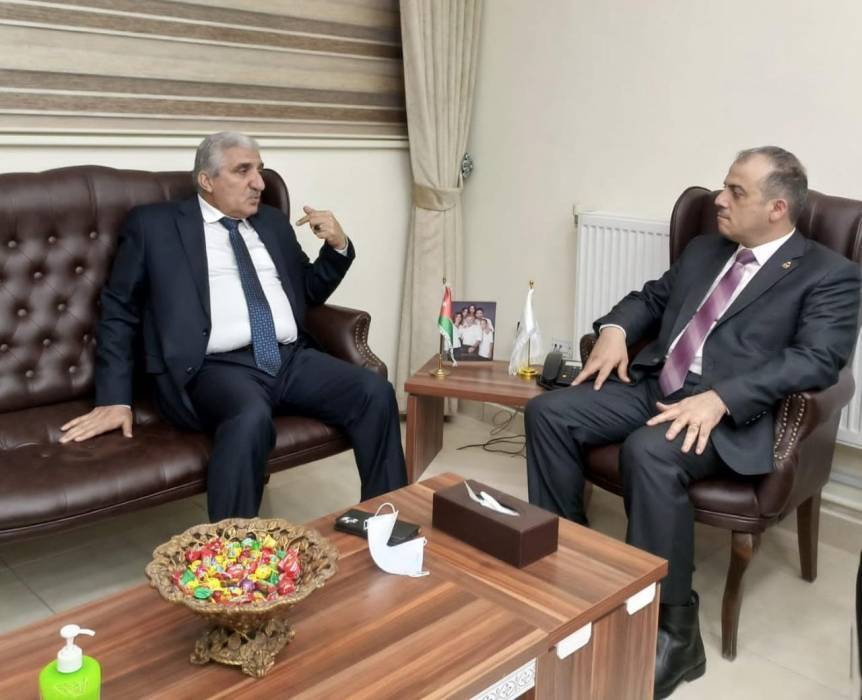
Dr. Nizar Haddad, the Director-General of the National Agricultural Research Center - NARC, expressed his appreciation to the joint cooperation between NARC and the Arab Center for the Studies of Arid Zones and Dry Lands (ACSAD) in many agricultural fields, especially in the fields of wheat, barley, small ruminants, capacity building and qualifying competencies.
In a statement today, Dr. Haddad said that the cooperation between the two sides extended to the livestock sector through the development camels and the provision of an improved herd of camels at Al-Khanasri Livestock Research Station to be a starting point for the development work of the camel sector to conduct scientific research in terms of genetic improvement, artificial insemination and camel productivity, and to find solutions to the challenges facing this sector. He further added that this herd was provided from local and regional sources to improve the camel sector due to its noticeable economic feasibility, especially for those with small projects, in addition to increasing the productivity of meat and milk through the intensification of genetic improvement experiments to serve the agricultural sector.
Haddad said that NARC has been conducting many research experiments on the camel sector for 3 years, and this herd came to enhance opportunities for cooperation, development and investment in the camel sector, highlighting that the Jordanian desert environment is one of the suitable environments for camel breeding, in addition to the animals that have characteristics of facing harsh climatic conditions and scarce water resources, in addition to the limited density of vegetation cover. "Camels with what God has endowed them with capabilities represented in many anatomical, physiological and behavioral characteristics enabled them to adapt and live in these conditions, where the value of camels as an important animal has been clear in areas where it is difficult for others to live". Haddad said.
On another note, the Director-General of ACSAD Dr. Naser Eddin Al Obaid, expressed his appreciation for the professional and research role played by NARC to develop the agricultural sector in Jordan, noting that ACSAD seeks to gather efforts in the region to develop agricultural scientific research in arid and semi-arid areas, and to exchange information and expertise, to benefit from the outcomes of scientific research and transfer, develop and localize modern agricultural techniques in order to increase agricultural and livestock production, in addition to facing the challenge posed by dry and semi-arid environments with fragile agricultural systems, and climatic changes in our Arab region, by providing scientific and applied data and advanced technologies, while expressing his pride in the research capabilities and infrastructure of NARC to achieve sustainable agricultural development.
Dr. Al Obaid further stated that ACSAD provided a group of camels to Al-Khanasri Livestock Research Station, aiming to stimulate and develop research related to the field of camels, especially with regard to the genetic improvement program and studies related to increasing the production of milk and meat from camels, in addition to studying the pastoral behavior of camels in the Arab deserts and characterizing the most important plants palatable by camels by the establishment of integrated systems of milk and meat production, and cooperation with the Ministry of Agriculture and the Ministry of Irrigation to develop the agricultural sector and achieve food security.
The Director of Livestock Research Directorate at NARC, Dr. Sami Al Awabdeh, confirmed that NARC provided a herd of camels that were available from different regions and from multiple genetic …
تابعو جهينة نيوز على